Description
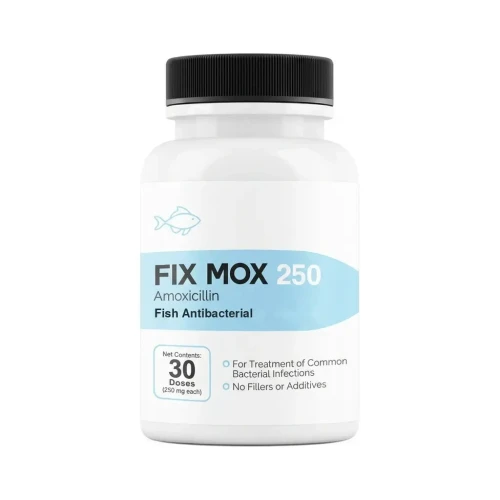
Fish Mox (Fix Mox) is amoxicillin in 250 mg and 500 mg capsules from Aqua Soma Labs, made for freshwater and saltwater aquarium fish. The label amount is 250 mg per 10 gallons of water, or 500 mg per 20 gallons, once every 24 hours for 5 to 10 days.
- Active ingredient
- Amoxicillin
- Strengths
- 250 mg or 500 mg per capsule
- Bottle sizes
- 30 or 100 capsules
- Label dose
- 250 mg per 10 gal (38 L), or 500 mg per 20 gal (76 L)
- Course
- Once every 24 hours for 5 to 10 days
- Made by
- Aqua Soma Labs, USA
What aquarists use fish amoxicillin for
Amoxicillin is a broad-spectrum penicillin-type antibacterial. It acts mainly on gram-positive bacteria and on some gram-negative ones, which is why it's often the first bottle keepers open when a bacterial problem is suspected and the cause isn't clear yet. Aquarists reach for Fish Mox when they see:
- Fins and tails that look ragged, frayed, or milky at the edges
- Red streaks, sores, or open ulcers on the body
- Inflamed or pale gills with fast breathing, when a bacterial cause is suspected
- A swollen body with raised scales (dropsy) in its early stage
- Cloudy, bulging eyes that follow an injury
It isn't the right choice for every sick fish. Amoxicillin does nothing against ich or velvet, flukes, anchor worms, or true fungal growth. If the spots look like salt grains, the fish flash against rocks, or you see cotton-like tufts, deal with the parasite or fungus first. Internal flagellates such as Hexamita respond to Fish Zole (metronidazole), not to amoxicillin.
Fish Mox dosage by tank size
Dose by the water you're treating, not by the number or size of the fish. Count the real volume of the hospital tank after decorations and gravel.
| Tank | Liters | 250 mg capsules per day | 500 mg capsules per day |
|---|---|---|---|
| 10 gal | 38 L | 1 | ½ |
| 20 gal | 76 L | 2 | 1 |
| 30 gal | 114 L | 3 | 1½ |
| 40 gal | 151 L | 4 | 2 |
| 50 gal | 189 L | 5 | 2½ |
| 75 gal | 284 L | 7½ | 3¾ |
| 100 gal | 379 L | 10 | 5 |
Half and quarter amounts mean splitting the powder from an opened capsule, so they're approximate. For tanks under 10 gallons, dissolve one 250 mg capsule in a measured cup of tank water and add the matching share. The label on your bottle always comes first.
How to treat with Fish Mox, step by step
- Move the fish. A bare hospital tank makes the dose accurate and keeps the antibacterial away from your display tank's biofilter, plants, and shrimp.
- Prepare the water. Take out activated carbon and chemical resins, and switch off any UV sterilizer. Both remove amoxicillin from the water. Add an air stone, because treated water holds less oxygen.
- Mix the first dose. Pull the capsule apart, dissolve the powder in a small glass of water taken from the tank, and pour it in slowly near the filter outflow.
- Repeat every 24 hours. Change part of the water before each new dose and dose for the full tank volume again.
- Keep going for 5 to 10 days. Stop at the end of the course, not when the fins start to clear. If nothing improves after 5 days, stop and rethink the cause.
- Finish clean. After the last day, make a larger water change and put fresh carbon back in for a day or two to pull out what's left.
250 mg or 500 mg, 30 or 100 capsules?
Both strengths hold the same amoxicillin, so the choice comes down to tank size and how often you treat. The 500 mg capsule is the strength many keepers know as Fish Mox Forte, and it means fewer capsules to open in a 30 gallon tank or larger. The 250 mg capsule is easier to dose accurately in 10 and 20 gallon hospital tanks.
For a 20 gallon hospital tank over a 10-day course you'll use 20 capsules of 250 mg or 10 capsules of 500 mg. At list price that works out to about $6.00 from a 100-count bottle of 250 mg, or $10.00 from a 30-count bottle of 500 mg. A 40 gallon tank uses 20 capsules of 500 mg, about $8.00 from the 500 mg 100-count bottle. If you keep more than one tank or quarantine every new fish, the 100-count bottle costs far less per course.
How Fish Mox compares with other Fix antibacterials
| Product | Antibacterial class | Mainly acts on | Pick it when |
|---|---|---|---|
| Fish Mox | Penicillin type (amoxicillin) | Gram-positive and some gram-negative | The cause is unclear and you want a broad first choice |
| Fish Flex | Cephalosporin (cephalexin) | Gram-positive and some gram-negative | Skin ulcers and wounds, or amoxicillin didn't help |
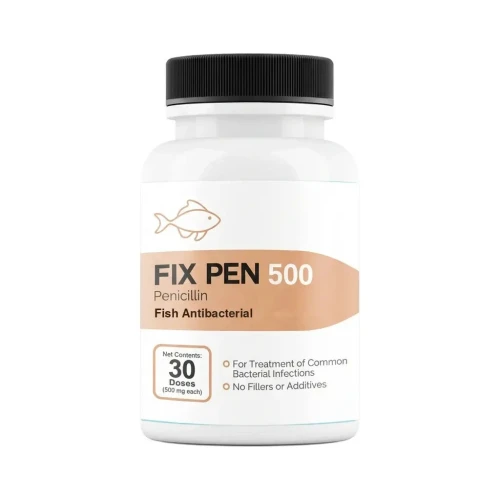
| Fish Pen | Penicillin V | Mostly gram-positive | A narrower option for wound and fin infections |
| Fish Flox | Fluoroquinolone (ciprofloxacin) | Mostly gram-negative | Fast-spreading ulcers or columnaris-type patches |
See every option side by side in our fish antibacterials overview.
Safety and tank notes
- Amoxicillin can knock back the nitrifying bacteria in a filter. Test ammonia and nitrite daily during treatment, especially in a display tank.
- Shrimp, snails, and other invertebrates are sensitive to many aquarium treatments. Keep them out of the treatment tank.
- Don't combine Fish Mox with other treatments unless you're following directions from an aquatic veterinarian.
- Keep the bottle closed, cool, dry, and somewhere children and pets can't get to it.
- Don't pour treated water or unused capsules into a sink or toilet. Ask your local waste service how to dispose of unused product.
Fish Mox questions
Fix Mox or Fish Mox: what's the difference?
Fish Mox is the name most aquarists search for amoxicillin capsules for fish. Fix Mox is Aqua Soma Labs' amoxicillin capsule, in the same 250 mg and 500 mg strengths with the same label dose. That's why we list it under both names.
What is Fish Mox Forte?
Forte is the name used for the 500 mg capsule. Choose 500 mg in the strength selector above.
Can I use Fish Mox in a saltwater tank?
Yes. The label covers freshwater and saltwater ornamental fish. Reef tanks with corals and invertebrates should be treated in a separate hospital tank.
Can I buy Fish Mox at Tractor Supply, PetSmart, or Amazon?
Stock of fish antibacterials in farm stores, big-box pet stores, and marketplaces changes often, and listings aren't always the strength you need. We keep both strengths and both bottle sizes in stock and ship from our Missouri warehouse the same or next business day.
The fish look better after 3 days. Can I stop?
No. Finish at least the 5-day minimum on the label. Stopping as soon as the fins look cleaner is the most common reason an infection comes back.
Can I dose the main display tank instead?
You can, but you'll need enough capsules for the full display volume, and the filter bacteria, shrimp, and snails take the hit along with the sick fish. A small hospital tank uses fewer capsules and keeps the rest of the tank stable. If you do treat the display, test ammonia and nitrite every day until the course ends.
For aquarium and ornamental fish only.